
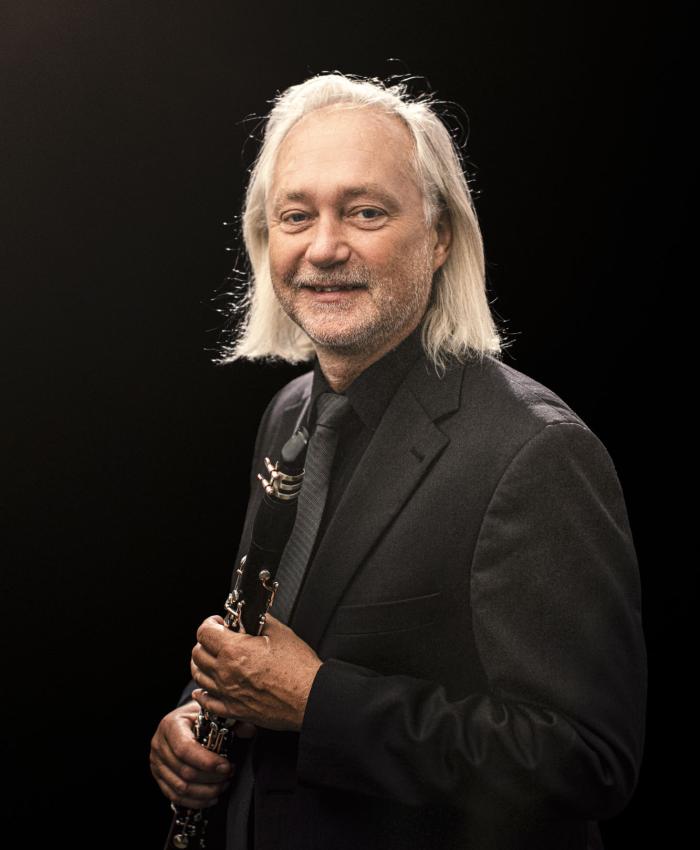
Wolfgang Klinser was born in Upper Austria in 1965 into a family of musicians. He received his first music lessons at the age of six from his grandfather, who taught composition and piano at the Vienna Conservatoire.
After eight years of clarinet lessons at music school, during which he won several prizes at the Austrian regional and national ‘Jugend musiziert’ competitions, he began studying clarinet as a performance major at the University of Music and Performing Arts Vienna under Professor Horst Hajek. Upon graduating with distinction, he was awarded the Commendation Prize by the Federal Ministry of Education and the Arts.
Wolfgang Klinser was principal clarinettist in various orchestras, most recently with the Munich Philharmonic, before accepting a post at the University of Music and Performing Arts Graz and devoting himself to chamber music and performing in chamber orchestras. He currently serves as principal clarinettist with the Camerata Salzburg and the Vienna Chamber Orchestra.
In 2012, he toured Australia, China and Japan as a guest solo clarinettist with the Vienna Philharmonic under Christoph Eschenbach.
He performs regularly as a soloist, including on several occasions at the Salzburg Festival with the Camerata Salzburg. He has also performed with this orchestra under Giovanni Antonini in the Great Hall of the Mozarteum, as well as at the Mozart Week in Salzburg in January 2014 under Louis Langree. At the Vienna Konzerthaus, he was a soloist with the Vienna Chamber Orchestra under the baton of Heinrich Schiff, and at the Haydn Days in Eisenstadt with the Austro-Hungarian Haydn Philharmonic under Christopher Hogwood. With this orchestra, he also appeared as principal soloist at the Liszt Academy in Budapest.
Chamber music tours have taken him to Japan, Italy, Switzerland, Germany, England, Venezuela, Lebanon and the United Arab Emirates.
Interview
In conversation with Wolfgang Klinser
Describe the CAMERATA in three words in your native language!
Freedom, energy, teamwork
What is it like for you to play in a chamber orchestra?
It feels like there’s more personal responsibility than in other ensembles.
Music is regarded as the ‘universal language of humanity’ – what ‘grammar’ do you think it follows?
Music is inextricably linked to language; the question of which came first is probably unanswerable. All the grammatical principles of language (intonation, nuances arising from psychological content, etc.) can be applied to music in a similar way; however, music, through its symbolic nature, further enhances and encodes these.
If the CAMERATA’s music were a culinary speciality from your home country – what would it be and why?
Steak, cooked medium and generously seasoned with pepper and salt.
What significance does classical music hold in today’s world?
The same as it has always had: to evoke memories of our aesthetic sensibilities, to bring joy (through this), relaxation and tension (both in a supportive context), to convey messages through its symbolic nature: in a gentle way.
What role does your instrument play when performing with the CAMERATA?
Those naturally assigned to the clarinet: often a vocal quality in solos, a warm tone, and otherwise frequently supporting the whole.
If Mozart were still alive: what would you like to say to him?
Thank you!!! Thank you!!! Thank you!!!


