
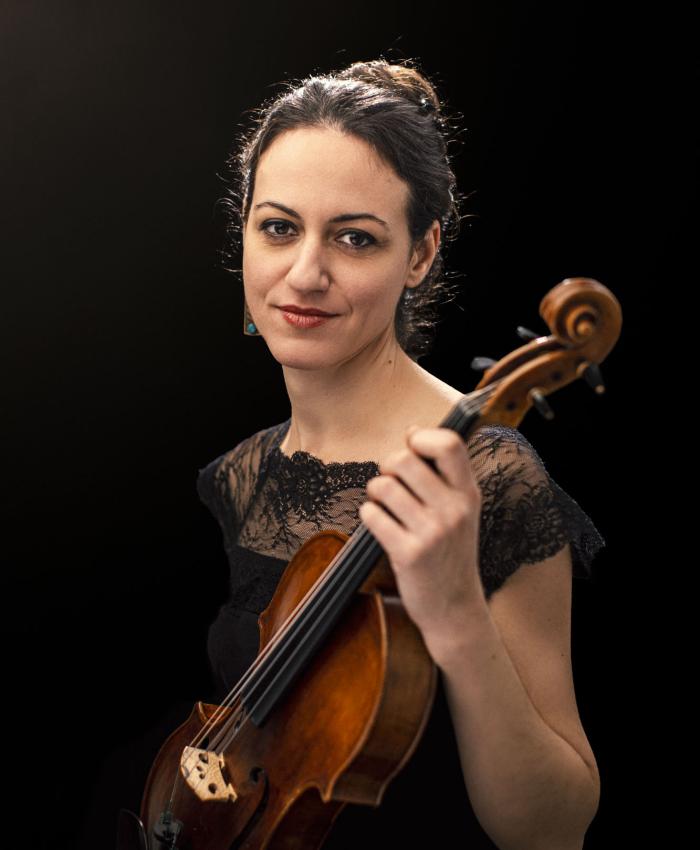
Danka Nikolic from Belgrade (Serbia) initially received her musical training at the Mozarteum University in Salzburg under Prof. Thomas Riebl, for whom she also worked as an assistant during her studies. She continued her studies at the Hamburg University of Music and Theatre under Prof. Thomas Selditz, graduating with distinction in 2008.
She has won prizes at numerous national and international competitions.
Danka Nikolic is a regular guest, both as a soloist and as a chamber musician, at international festivals (Hagen Open, Dialoge Salzburg, Styrian Chamber Music Festival, among others). Her chamber music partners include renowned musicians such as Eliot Fisk, Stefan Schilli, Juan Diego Flórez, Thomas Selditz and Lukas Hagen.
She is a member of the Camerata Salzburg, principal violist with the Deutsche Kammerakademie Neuss, and a regular guest with various orchestras, such as the Chamber Orchestra of Europe, the Balthasar Neumann Ensemble and the Basel Chamber Orchestra, where she performs as principal violist.
Danka Nikolic is a founding member of the Schallmoos String Trio and the Ensemble Quirin. She places particular emphasis on period performance practice and plays the Baroque viola and the viola d’amore.
Interview
In conversation with Danka Nikolic
Describe CAMERATA in three words from your native language!
Community, understanding, flexibility.
If CAMERATA’s music were a culinary speciality from your home country – what would it be and why?
Leskovačka mućkalica. It’s a hot dish that originates from the south of Serbia and contains lots of different ingredients: meat, bacon, various vegetables, spices – it can even be a bit spicy… everything is mixed together and roasted in the oven. All the ingredients are simple, and it’s not difficult to prepare, but the result is an exquisite flavour that fills you with warmth and contentment!
What role does your instrument play when performing with the CAMERATA?
It occupies the golden mean and creates a connection between the high and low registers.
What does ‘good ensemble playing’ mean to you?
Listening to one another, responding and thus shaping the music flexibly together, whilst each individual brings their own unique personality and energy to the performance.


