
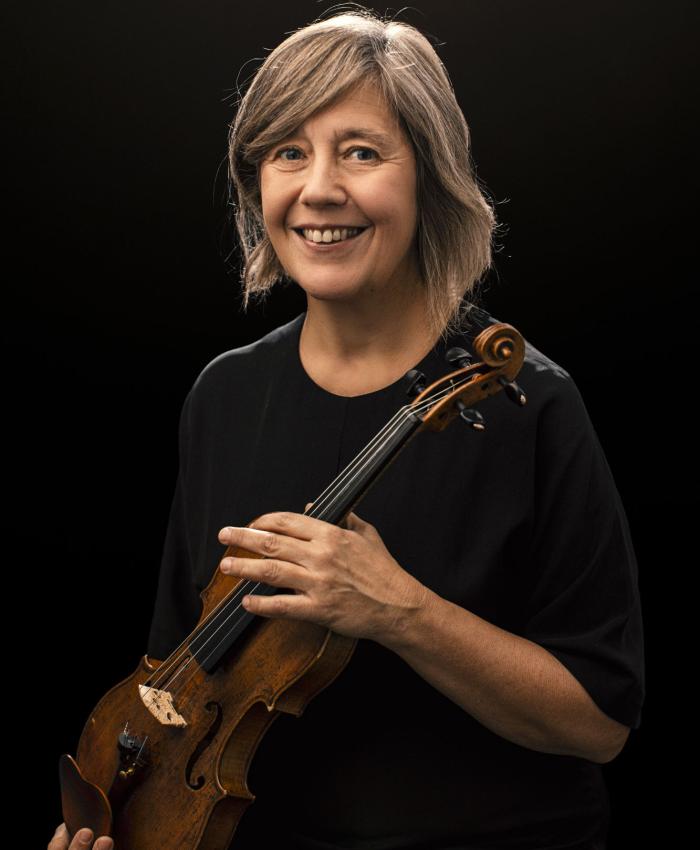
The Viennese violinist Annelie Gahl is the recipient of the Anton Bruckner Prize and the Paula Boleszny Prize. Immediately following her studies with Paul Roczek, Ernst Kovacic, Herman Krebbers and Shmuel Ashkenasi in Salzburg, Vienna, Amsterdam and the USA, her collaboration with Sandor Vegh and Nikolaus Harnoncourt – in whose orchestras, the Camerata Salzburg and Concentus Musicus, she performed – had a formative influence on her artistry.
In addition to her regular work with these ensembles, she has stood in as concertmaster with the Wiener Akademie and the RSO Wien.
Her focus on contemporary music has also been instrumental in her versatile and dynamic career. This has involved her appearing both as a regular guest at the Klangforum Wien and as a soloist. Her creative programmes, often interlinked with literature, dance and the visual arts, have taken her to festivals such as Wien Modern, the Salzburg Festival, the Salzburg Biennale, the Osterfestival Hall, Styriarte, the Ulrichsberger Kaleidophon and the Festival Imago Dei, as well as to the Philharmonie Luxembourg, amongst others.
Annelie Gahl gained international recognition through her solo recordings, released on Extraplatte, collegno and Kairos, in which she combines early and contemporary music. Her recording of Cage’s works, made in collaboration with the composer Klaus Lang, was immediately awarded the ORF’s Pasticcio Prize; the German magazine *Rondo* described it as “arguably the finest in many years”, whilst *Strad* magazine raved about an “auspicious and exciting solo debut”, whilst the *Salzburger Nachrichten* attested to her “remarkably focused violin artistry”.
As a soloist, she has generated great enthusiasm in recent years with the Austrian premieres of both Armanda Maier Röntgen’s Violin Concerto (1875) and Ethel Smyth’s Double Concerto for Violin and Horn (1928). Furthermore, she has performed works by Ludwig van Beethoven, Antonio Vivaldi and Steve Reich with the Camerata Salzburg, the Salzburg Chamber Philharmonic and the Sinfonietta Danubia. As a chamber musician, she has performed with, amongst others, Benjamin Schmid, Ivry Gitlis, Lukas and Veronika Hagen, the Hyperion Ensemble, as well as members of the Klangforum Wien and the Camerata Salzburg.
Since 2000, a key focus of her work has been teaching at the Mozarteum University, where she has been leading a violin class since 2017. She supplements this work with masterclasses and ensemble coaching in Austria, Israel, Poland, Germany, Moscow and China.
Interview
In conversation with Annelie Gahl
Describe the CAMERATA in three words in your native language!
spirited, down-to-earth, ready for excitement
What is it like for you to make music in a chamber orchestra?
The principle of ‘live and let live’ means that giving and taking, responsibility and visibility rest with everyone at all times – a very refreshing way of working together, a highly active process whilst at the same time feeling secure in the bonds we’ve forged together (trust)
What significance does classical music hold in today’s world?
Concerts, even in the classical format as an opportunity for deliberate listening, are generally oases of communication; the significance of classical works, in their existential nature, transcends time.
If Mozart were still alive: what would you like to say to him?
Thank you!
For you, chamber orchestra music is …
…enriched chamber music.
What would you like the audience to take away from your concerts?
I’d like the audience to embrace and find joy in their full range of emotions – the personal strength that comes from giving it your all.
What does ‘good ensemble playing’ mean to you?
Live and let live – and do both wholeheartedly.
What is the most important moment for you during a concert?
It’s the moment just before the first note.
What do you find particularly appealing about the CAMERATA Salzburg?
Versatility
What has been your most memorable experience with the CAMERATA Salzburg so far?
It was the shower of roses at the Teatro Colón after the Dvořák Serenade with Sandor Végh.


